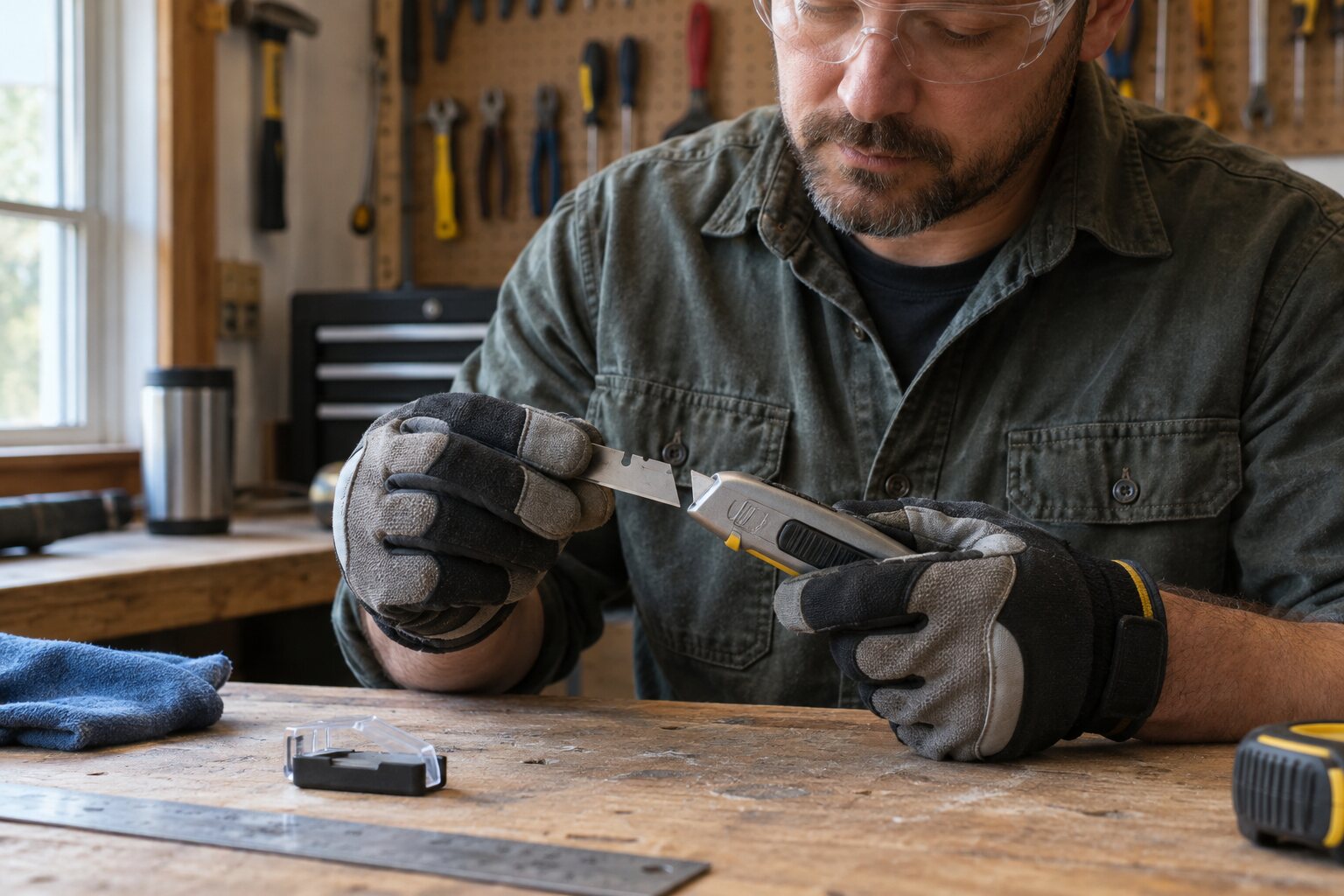
A dull utility knife blade is harder to control than a sharp one because it takes more force and may suddenly slip. Replacing it safely means controlling the blade at every stage, keeping your hands out of the cutting path, and disposing of the old edge immediately.
Prepare a controlled work area
Work on a stable bench with bright light and no loose paper, cords, or children nearby. Put on eye protection if the knife uses a spring-loaded blade or a removable cartridge. Read the handle’s instructions before opening it; some models use a screw, some use a sliding lock, and others have a quick-change mechanism. Never improvise with a blade that does not match the handle.
Retract and open the knife
Retract the blade completely and lock the slider. Hold the handle with the cutting edge pointing away from you while opening the housing. If the handle has a screw, keep the small parts in a shallow tray so they cannot roll under the bench. Do not grip the exposed edge, even if you believe it is dull; use the spine or a folded cloth only where the design permits.
Remove and install the replacement
Lift the old blade by its unsharpened spine and place it directly into a rigid sharps container. Align the new blade with the guide pin or notch, keeping fingers behind the blunt portion. Confirm that the cutting edge faces the correct direction before closing the handle. Tighten the fastener firmly but do not strip it, then check that the slider moves smoothly and stops at its intended positions.
Test without cutting
With the knife pointed away from your body, extend only a short section of blade and gently test the lock by applying light pressure to the back of the blade. If it shifts, retract it and reopen the handle. Never test a replacement blade against your thumb or palm. Wipe away any manufacturing oil with a disposable cloth, then store the knife closed in a dry place.
Mark the sharps container and keep it closed until disposal rules in your area allow it to be dropped off. A small blade change becomes a safe routine when the work area, hand position, and disposal step are treated as part of the repair.