
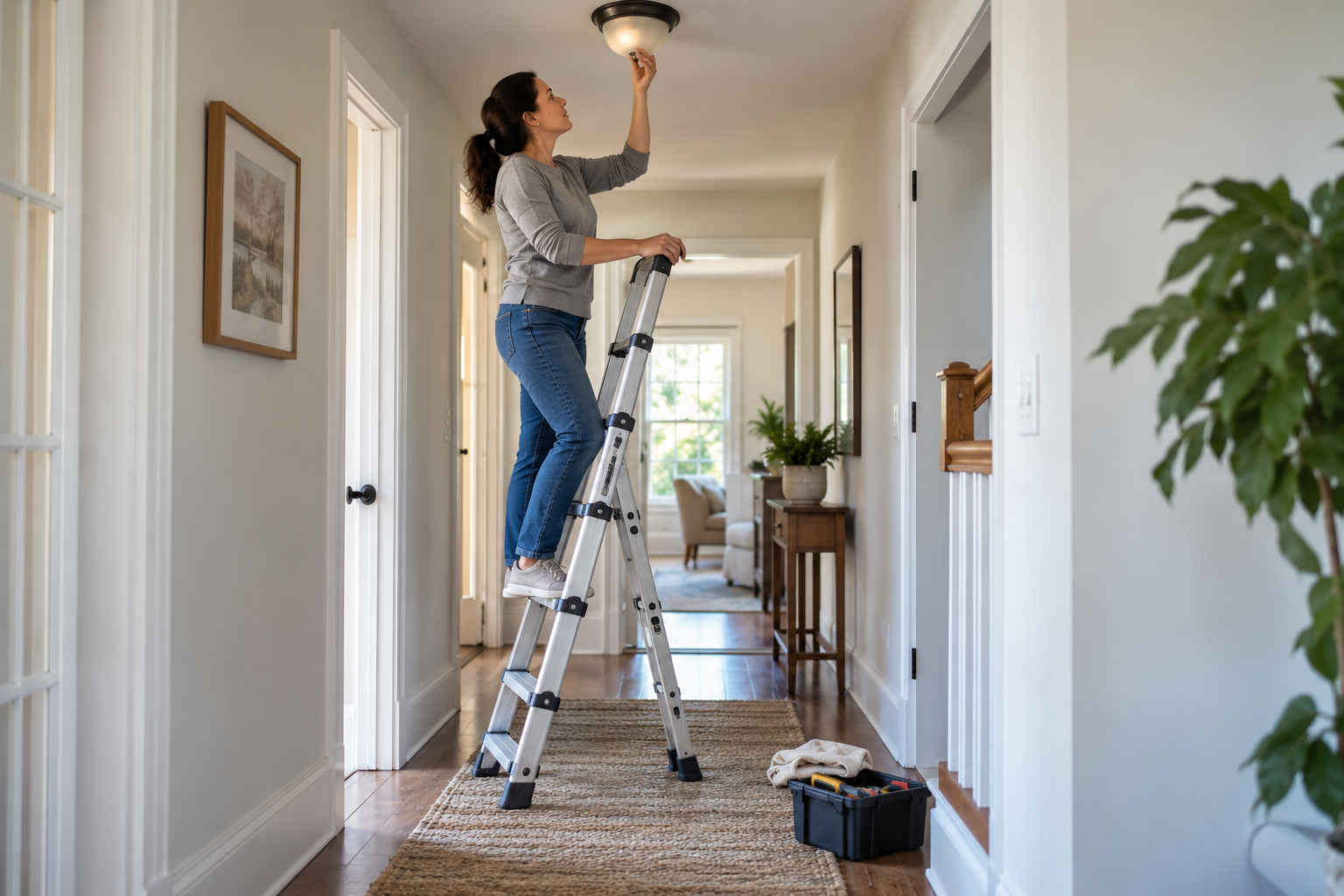
A ladder is one of the most useful tools in a home, but it is also one of the easiest to choose badly. A model that is too short encourages stretching. One that is too tall may be awkward indoors. The best choice is not the ladder with the biggest number on the label; it is the ladder that fits the job, the room, and the way you actually work.
Start with the job, not the ladder
Write down the highest point you need to reach and the kind of surface beneath you. Changing a ceiling bulb in a hallway is a different task from cleaning a gutter. Indoors, a small step ladder may be the safest and most convenient option. Outdoors, a taller extension ladder may be necessary, but it also demands more space, a level setup, and greater attention to overhead hazards.
Measure the working height rather than guessing. Your hands should reach the work comfortably while your feet remain on an approved standing step. You should never have to stand on the top cap or the highest step marked with a warning. If the job requires leaning far to one side, the ladder is not giving you the right access.
Step ladders for everyday indoor work
A step ladder is usually the right first purchase for ordinary household maintenance. Three or four steps can cover light fixtures, curtain hardware, upper cabinets, smoke alarms, and many painting jobs. Look for a broad top platform, a stable spreader, non-slip feet, and steps that are deep enough for both feet when you pause.
For a small home, a lightweight aluminum ladder is easy to carry, while a fiberglass model is a better choice when electrical work may be nearby. A ladder is not a substitute for turning off power. Before touching a light fixture, switch off the breaker and verify that the circuit is dead with a properly rated tester.
Extension ladders need room to work
An extension ladder is useful for roof edges, high siding, and tall exterior windows, but its length is only one part of the decision. It must extend above the landing point enough to provide a secure handhold, and it must be placed at a safe angle on firm ground. Keep the base away from doors, wet leaves, loose gravel, and areas where someone could move it accidentally.
Check for overhead electrical lines before carrying or raising an extension ladder. Never use a metal ladder near energized conductors. If the ground slopes, the ladder should not be improvised with bricks, scrap wood, or loose objects under one foot. A difficult setup is a strong sign that the task belongs to a professional.
Inspect the ladder before every use
- Look for bent rails, cracked steps, loose rivets, and missing hardware.
- Make sure the feet and end caps are present and have usable tread.
- Open a step ladder fully until the spreaders lock.
- On an extension ladder, confirm that the locks engage evenly.
- Clean oil, paint, mud, and moisture from the steps before climbing.
Do not assume a ladder is sound because it worked last month. Plastic feet can harden, fasteners can loosen, and a small bend can change the way the rails carry weight. Store the ladder where it will stay dry and supported, rather than leaning it permanently against a wall where it can be knocked over.
Use three points of contact
When climbing, keep two hands and one foot, or two feet and one hand, in contact with the ladder. Carry small tools in a belt or raise them after you are positioned. A tool tray is useful only when it does not encourage overreaching. Move the ladder instead of twisting your torso to reach the last few inches.
Ask someone to steady the ladder while you set it up, especially on an unfamiliar surface. A helper should not try to catch a falling ladder after it has started to slide; the safer role is to keep people away from the work area and help confirm that the setup is stable before climbing.
Know when to stop
Stop if the ladder rocks, the floor shifts, the weather changes, or the work requires force that could pull you sideways. Do not climb with wet shoes, bulky clothing, or materials that block your view. If you need both hands for a heavy object, a taller access system, or a long period of work, a ladder may not be the right equipment.
The practical test is simple: you should be able to set the ladder on a firm surface, reach the work without stretching, and climb down without rushing. If those conditions are not possible, choose a different ladder or hire someone with the right equipment. A well-matched ladder makes a small repair easier; it should never make the repair feel like a balancing exercise.